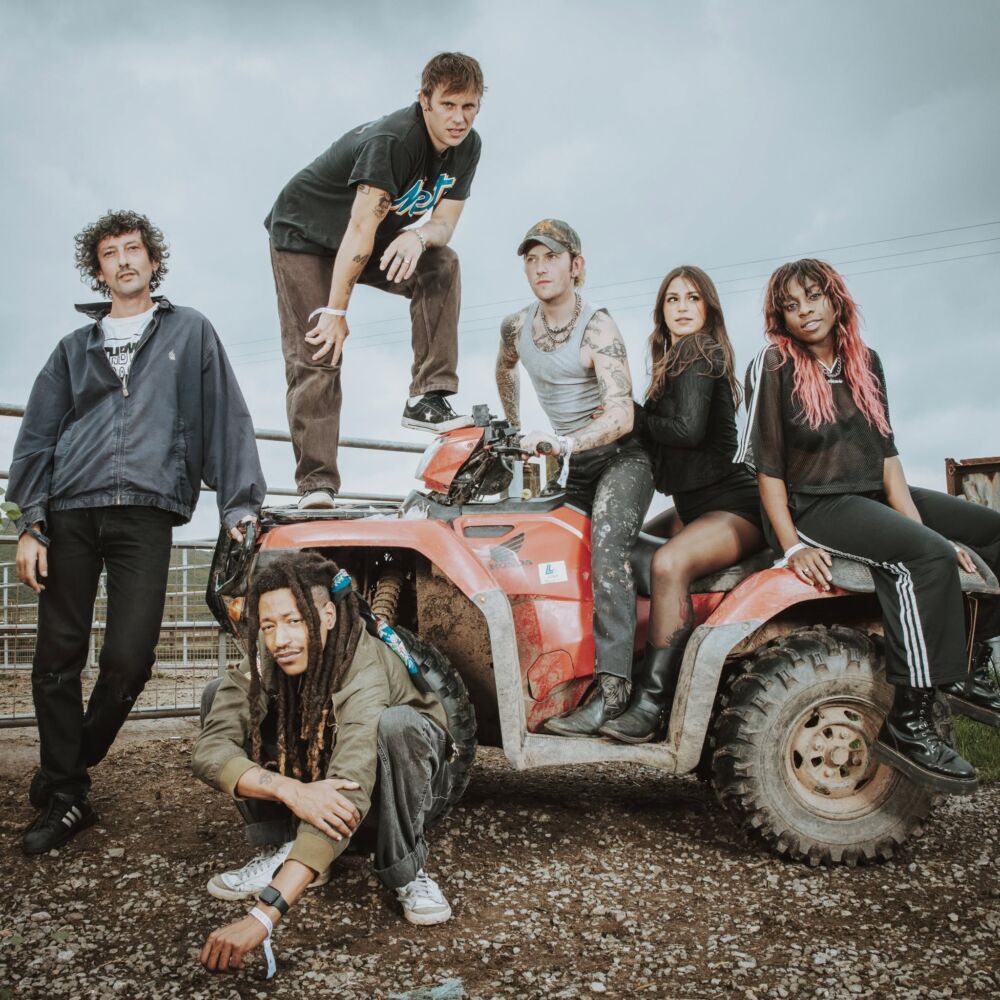
Moins d’un an après Party Time, le groupe de Brooklyn TVOD remet le couvert avec « The Farm », un album enregistré en deux semaines à Leeds, sous la houlette de Danny Blackburn (Adult DVD). Né dans les caves et les sous-sols de la scène DIY new-yorkaise, le groupe reste fidèle à sa recette : un punk nerveux, hyper dansant, qui n’a pas peur de dire ce qu’il pense. Et heureusement. Inspirés par La Ferme des animaux d’Orwell, cette fois, TVOD troquent la fête contre la satire politique, avec en exergue un sens de l’ironie bien à eux où le moshpit est un acte de résistance. Tyler Wright, chanteur, compositeur et leader du combo, nous parle de la création de cet opus, de l’absurdité du monde, de liberté et de pintes partagées.
Moins d’un an après Party Time, vous revenez déjà avec The Farm. Aviez-vous encore trop de chansons en tête, ou simplement trop d’énergie à dépenser ?
Je n’arrive tout simplement pas à rester créativement inactif. C’est un problème. Si ça ne tenait qu’à moi, je sortirais un album toutes les semaines, mais des forces supérieures et de plus raisonnables m’en empêchent.
Vous avez commencé à écrire une partie de l’album dans une ferme à Neufchâtel-en-Bray. Qu’est-ce que ce séjour à la campagne, loin du bruit et de l’agitation de Brooklyn, a apporté au processus ?
Ça a apporté beaucoup de clarté, de calme et de direction au groupe. On est nombreux, alors se retrouver tous dans un endroit inconnu avec rien d’autre que nos instruments et du vin, c’était le combo parfait. Il y avait même un jacuzzi. Soyons honnêtes, on s’est fait plaisir.
Le titre The Farm fait écho à La Ferme des animaux de George Orwell. À quel moment avez-vous décidé de transformer cette satire du pouvoir en matière à chansons punk ?
Je crois que c’était dans le van, quelque part plus tard pendant cette tournée, quand quelqu’un a évoqué avoir lu le livre. On s’est tout de suite mis à parler des similitudes entre l’époque actuelle et celle décrite dans le roman, puis on a constitué un petit groupe de lecture pour le relire. Je le recommande vivement à tous ceux qui lisent ces lignes. C’est une lecture incroyablement courte et pourtant profonde. Le livre m’a donné envie d’essayer d’écrire des sketchs ironiques sur l’absurdité de tout ça.
Avec ce nouvel album, vos textes prennent une dimension plus politique. L’absurdité du monde vous inspire-t-elle davantage ces temps-ci, ou avez-vous simplement trouvé une nouvelle façon de s’en moquer ?
Honnêtement, l’absurdité n’est pas très inspirante ces temps-ci, et j’espère ne pas faire injure à la gravité de notre époque en m’en moquant. J’espère vraiment que cet album sera un outil au service du bien, qu’il contribuera à améliorer cet endroit qu’on appelle chez nous et à résister aux forces qui essaient de nous déchirer.
Vous avez enregistré The Farm à Leeds avec Danny Blackburn (d’Adult DVD) en deux semaines. En quoi cette nouvelle collaboration a-t-elle changé votre façon de travailler par rapport à Party Time ?
Danny avait une vision similaire de la sonorité qu’il voulait pour ce disque. Il nous avait beaucoup vus en live quand on a fait quelques petites séries de dates avec Adult DVD en tournée l’été dernier, donc il savait ce qu’on cherchait et la direction dans laquelle on voulait aller. C’est aussi un type vraiment bien, et j’espère qu’on aura l’occasion de retravailler ensemble. Il y a eu plein de pintes, de bons moments et de nouveaux amis au Nave Studios pendant l’enregistrement.
Votre musique reste férocement dansante, même quand elle aborde les tensions sociales, le pouvoir ou la désillusion. Faire danser les gens sur des sujets qui fâchent, est-ce une forme de provocation supplémentaire ?
Oh que oui. « The man » (le système) ne veut pas que vous dansiez. Il ne veut pas que vous vous exprimiez. Il ne veut surtout pas que vous alliez à un « concert punk » où les gens peuvent bouger leur corps dans toutes les directions et se relever quand ça tourne mal.
Toute cette liberté est viscéralement cathartique, et ils ne le supportent pas. Dans un monde qui peut parfois sembler ordonné et oppressant, le pogo est l’endroit idéal pour s’évader et être soi-même.
TVOD est né d’une éthique DIY et d’une forte culture underground. Avec les festivals, les tournées internationales et l’attention portée à Party Time, comment préserver cet esprit sans vous faire avaler par la machine ?
Je pense qu’on a plutôt les pieds sur terre et qu’on ne laisse pas trop cette attention nous atteindre. On adorera toujours un concert en sueur dans la cave de la demi-sœur de la grand-mère de quelqu’un. C’est ce qui a fait de nous ce qu’on est aujourd’hui, et on ne l’oubliera jamais.
Pour finir : si Party Time était une invitation à faire la fête malgré les jours difficiles qui pourraient suivre, quelle est la meilleure approche pour survivre à The Farm ?
Je ne crois pas qu’on survive à The Farm… Tu es déjà mort. Tu es déjà mort ! Ahhh !!!
Interview in English
Less than a year after « Party Time », the Brooklyn-based band TVOD returns with « The Farm »—an album recorded over two weeks in Leeds under the guidance of Danny Blackburn (Adult DVD). Born in the cellars and basements of the New York DIY scene, the group remains true to its signature formula: high-energy, danceable punk that isn’t afraid to speak its mind. Inspired by Orwell’s *Animal Farm*, TVOD swaps party vibes for political satire, employing a unique brand of irony where the mosh pit becomes an act of resistance. Tyler Wright—the band’s singer, songwriter, and frontman—discusses the making of this record, the absurdity of the world, the nature of freedom, and sharing a few pints.
Less than a year after Party Time, you’re already back with The Farm. Did you still have too many songs in your head, or simply too much energy to burn off?
I just can’t keep creatively still. It’s a problem. If it were up to me I would release an album every week, but the forces at bay and better minds keep me from doing that.
You began writing part of the album at a farm in Neufchâtel-en-Bray. What did that time in the countryside, far from the noise and bustle of Brooklyn, bring to the process?
It brought a lot of clarity, calmness and direction to the group. We are so many people, so all of us being able to be in a foreign place with nothing but our instruments and some wine was a perfect combo. There was also a hot tub. Let’s be honest here, we were enjoying ourselves.
The title The Farm echoes George Orwell’s Animal Farm. At what point did you decide to turn this satire of power into fodder for punk songs?
I think it was in the van somewhere later on that tour when someone brought up reading the book. Immediately we began talking about how similar times are now to it, then made a band pack to read it again. I strongly suggest it to everyone that is reading this right now. It’s a wildly short read and yet it is profound. The book got me excited to try and do some tongue in cheek sketches about the absurdity of it all too.
With this new album, your lyrics take on a more political dimension. Does the absurdity of the world inspire you more these days, or have you simply found a new way to mock it?
Honestly the absurdity is not too inspiring these days and I hope I don’t do the gravity of our current times an injustice by mocking it. I really hope this album is a tool for good, bettering this place we call home and standing up against the forces that try to tear us apart.
You recorded The Farm in Leeds with Danny Blackburn (of Adult DVD) over the course of two weeks. How did this new collaboration change your way of working compared to Party Time?
Danny had a similar direction in how he wanted this record to sound. He saw us live a lot when we did a couple little runs together with Adult DVD on tour last summer, so he knew what we were going for and the direction we wanted to point ourselves in. He’s also just a really fine bloke and I hope we get to work on more stuff together in the future. There was a
lot of pints, good times and new friends at Nave Studios when we made this record.
Your music remains fiercely danceable, even when addressing social unrest, power, or disillusionment. Is getting people to dance to contentious topics a further form of provocation?
Hell yea it is. “The man” does not want you to dance. He doesn’t want you expressing yourself. He most certainly as shit does not want you going to a “Punk Show” where people are able to move their bodies in any direction they please and pick themselves up when things go wrong. The whole freedom of it all is viscerally cathartic and they can’t stand it. In a world that can sometimes seem orderly and oppressive the moshpit is a perfect place to escape and be yourself.
TVOD was born out of a DIY ethos and a strong underground culture. With festivals, international tours, and the attention surrounding Party Time, how do you preserve that spirit without being swallowed up by the machine?
I think we have somewhat decent heads on our shoulders and don’t let the attention bother us too much. We will always love a sweaty show in someone’s grandma’s, step sister’s basement. It made us who we are today and we will never forget that.
To wrap up: if Party Time was an invitation to celebrate despite the difficult days that might follow, what’s the best approach for surviving The Farm?
I don’t think you do survive The Farm…You’re already dead. You’re already dead! Ahhh!!!
Photo de couv. TVOD RD
Traduction Lucas Perraux